You don’t need a passport or an international flight to gain a global perspective. Sometimes the most transformative cross-cultural experience happens right in your own backyard. At least, that’s what the American participants in our American Summer Exchange keep telling us.
Every summer, U.S. university students live and work alongside students from around the world at iconic American host locations. Their international coworkers arrive through the U.S. Department of State’s Summer Work Travel program, which brings young people to the United States to share their culture and ideas through temporary work and travel. The two groups share shifts, housing, and days off, which turns an ordinary summer job into a two-way exchange. This summer, the InterExchange team visited host sites in Utah and New Jersey to ask the American participants what that experience had actually done for them.
The network builds itself
Ask a participant where their coworkers are from and the answer is never a single country. Gordon, from Mississippi, spent his summer at Stein Eriksen Lodge in Park City, Utah, working alongside colleagues from Mexico and Colombia, with roommates and friends from Romania, Croatia, and North Macedonia. “Really all over the world,” he said.
For Ulysses, from Tampa, Florida, the appeal of the summer came down to one thing: being somewhere new in his own country while helping people who had never been there before find their footing. His favorite part, he said, was “living in a different city in America and meeting everyone who has never lived in America and helping them acclimate and learn from them.” By August he had collected a small working vocabulary, including how to say good morning in Lithuanian (labas rytas) and in Macedonian (dobro utro).
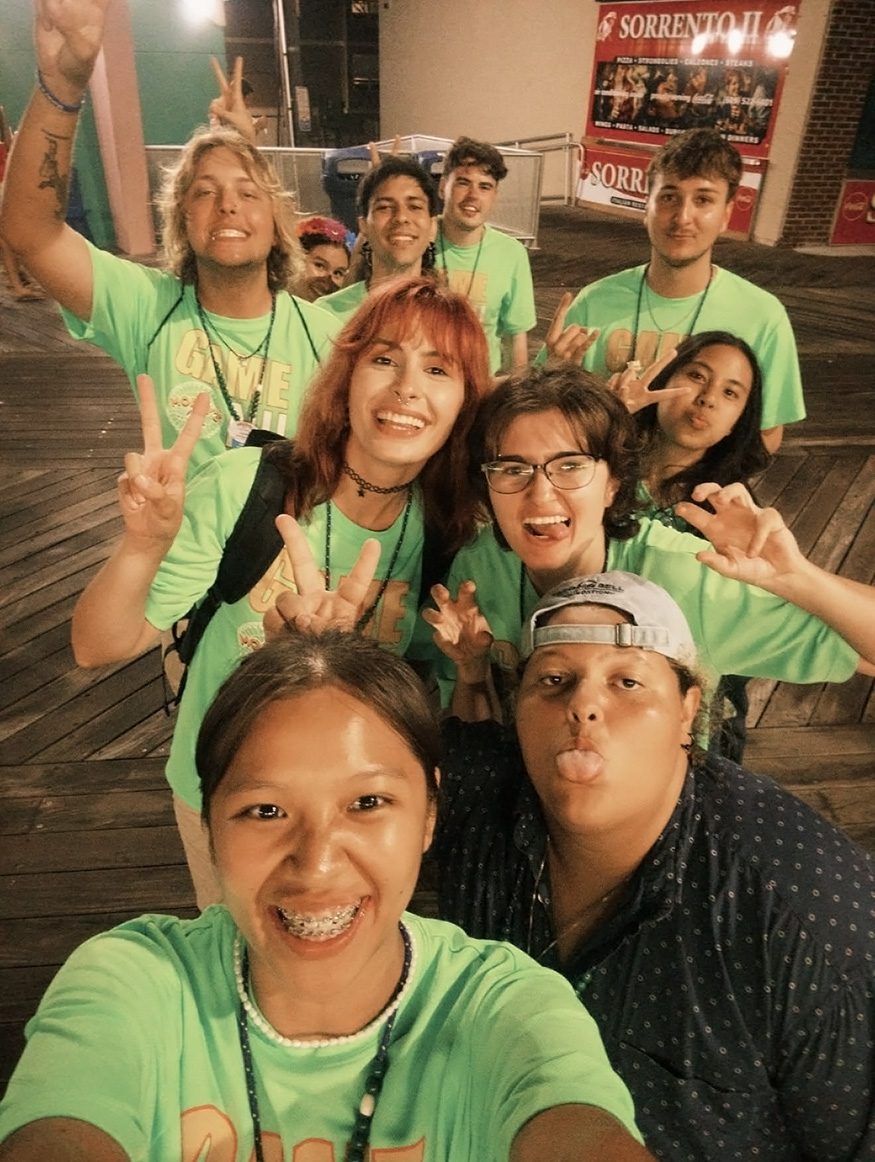
At Morey’s Piers in Wildwood, New Jersey, Kirsten described a turnover of introductions that never really stopped. “There’s a new person and new culture every time,” she said. The conversations ranged wider than small talk; she and her coworkers compared how their education systems were structured and how differently medical care worked from one country to the next.
For Max, from Maryland, some connections landed closer to home than he expected. Max’s father is from Moldova, and he found himself surrounded by Romanian speakers for the first time in his life.
Seeing America through fresh eyes
The second thing participants notice is their own country, which starts looking unexpectedly remarkable once they have to explain it.
On the Fourth of July, Gordon hosted about twenty coworkers and was the only American in the group. He ran the grill, taught everyone how to cook hot dogs, and walked them through mustard and ketchup—what he called “the full American experience.” Fast food turned out to carry the same charge. Many of his friends, he said, saw it as “something out of a movie that isn’t real,” and he found real pleasure in taking them and watching their excitement at ordering and waiting for a number to be called.
Working in Utah gave him a second angle on the same phenomenon, since he was discovering an unfamiliar part of the country at the same time his coworkers were. His international friends were struck by how many churches they passed, a detail he had never thought to notice. Being able to see “what is surprising to people and what’s not,” he said, was its own education.
Kirsten had a similar realization watching her friends plan their travel. A group of them had just gone up to New York to catch a World Cup match, and their itineraries stretched well past the boardwalk. “They have so many plans to see this country,” she said. “And I’m like, wow, they’re seeing more than I will.” A friend from Poland told her that Poles tend to shrug about their homeland; what struck him about the U.S. was how much pride people take in it.
Over the course of the American Summer Exchange program—and continuing well after the summer has ended—participants are encouraged to reflect upon what they’ve learned about other cultures as well as their own cultural identity. Asked whether the experience changed how he felt about his own country, Max kept it short. It made him appreciate it a little more, he said, but it also made it look different.
Discovering parts of themselves
Put a college student somewhere nobody knows them, among people who don’t share their references, and something clarifying tends to happen.
Ulysses learned something about how he recharges. Most of his friends went out after every shift; he preferred his days off at home. “I’ve learned that I don’t need as many friends as everyone else does,” he said.
For Kirsten, a summer spent introducing herself to strangers turned into accidental preparation for freshman year. She had been nervous about starting college, she said, until she realized the summer was the same exercise: arriving somewhere she knew no one and talking to people anyway. By the time she leaves for school, it will be the second time she’s done it.
Kirsten, whose family background is both Filipino and American, also had advice for future participants who arrive holding more than one culture. There’s a moment, she said, when it feels like one has to win out over the other, or that having two isn’t allowed when everyone around you seems to have one. Her answer was to refuse the choice. “As long as you’re sure of yourself, the prouder you are of it and the more comfortable you feel sharing it, the better you’re going to feel here. Be very sure that you’re here and that you’re both.”
Max, who wants to work in space one day, treated the summer as professional training. The International Space Station, he pointed out, is a fundamentally international project, and the field intends to keep it that way. Experience with other cultures, in that line of work, is a qualification.
Gordon offered the summary most participants would probably sign. “You learn a lot, not only about other people but about yourself,” he said. Your own culture and your own experiences get “brought into question,” along with how much you enjoy the things you took for granted that other people see as extraordinary.
The world, closer than expected
American Summer Exchange delivers the language exchange, the friendships across time zones, and the jolt of seeing the United States from the outside. What it skips is the passport, the airfare, and a semester of tuition abroad. The program places U.S. university students at partner sites nationwide each summer, and applications open in January.
Gordon, who has studied abroad in the past and loved it, still makes the case for stateside experiences. It’s a great way, he said, to “meet new people and get international experience while still staying in your backyard.”