
Blogpost
Marketing
Career Training USA

Road Safety in the U.S.

Driving & Biking in the U.S.

If you intend to drive or bike in the United States, you’ll need to familiarize yourself with local, state, and federal laws regarding driving. The best recommendation is to consult the Department of Motor Vehicles (DMV) in the state in which you plan to drive. Most U.S. states recognize foreign driver’s licenses, but you should carry your passport with you as well if you’re driving. Please consult the DMV in the state where you wish to drive to confirm the length of validity. Local DMV offices may be found through an Internet search, or by visiting the state’s official DMV website.

We strongly recommend that you obtain an International Driving Permit (IDP) before you leave your home country. (You cannot get one after arriving in the U.S.) Depending on the date you obtained your International Driving Permit, it should be valid in all states for up to a year.

Remember:

  • Cars drive on the right side of the road in the U.S.
  • Never drive after drinking alcohol and never get into the car with a driver who has been drinking.
  • Always wear a seat belt.
  • Stay on marked roads
  • Follow posted speed limits.
  • Be aware of special weather and road conditions (e.g., snow, fog, flooding and detours/construction)
  • Use extra care around school buses, trucks and large vehicles
  • Follow parking rules
  • Be aware of pedestrians and bicyclists
  • Do not text or use your cellphone when driving
  • Don’t always trust GPS. Be aware of Road Closed and Bridge Out signs to steer clear of danger.
Foreign Driver’s License (Home Country Driver’s License)

Some U.S. states recognize foreign drivers’ licenses when accompanied by your international passport. In most cases, your license may be valid for up to 4 months after the date you enter the U.S. However, please consult the DMV in the state where you wish to drive to confirm the length of validity and the rules for driving with a foreign driver’s license. The rules vary by state; some require that you have an International Driving Permit and some don’t.

Obtaining a Driver’s License in the United States

In some states, it may be possible to obtain a U.S. license. You will need to contact the local Department of Motor Vehicles in the state where you will be working to find out whether you’re eligible to apply for a U.S. driver’s license. If eligible, obtain a copy of the state driver’s manual from the DMV so that you can learn that state’s driving rules, and study for the written test and the driving test. Ask which documents you need to present to the DMV when applying for a license. These required documents will vary by state.

At a minimum, you will probably be required to show the following documents in order to apply for a U.S. state driver’s license:

  • Passport
  • Home country’s driver’s license
  • International driver’s license
  • Social Security card
  • Proof of residency in the state

Motorcycles require a special driver’s license, and many states have laws requiring that you wear a helmet. The accident and sickness insurance provided by InterExchange will not cover you in the event of an accident while you are driving a motorcycle.

In the event of a car accident, find out if anyone is injured. If someone requires medical attention, or to report the accident, dial 911 from any phone. 911 is the free direct number for emergency services with the local police anywhere in the U.S. If possible, do not move your car until the police arrive and are able to assess the accident scene. While waiting for the police, exchange the following information with the driver of the other car:

  • Name, telephone number, and license ID number.
  • License plate number, model and year of the car.
  • Registration number and expiration date.
  • Name of the insurance company and policy number.

If there are any witnesses, ask for their names, telephone numbers and addresses in the event of insurance disputes. If you have a phone with a camera, take pictures of the damage and accident scene. If you have hit a parked car, you must leave your name, phone number and license plate number on a piece of paper and put it under the windshield wiper, so they may contact you. Also write down the car’s license number and model of the car.

Failure to leave your information or report the accident is considered a crime.

Make sure that any car you drive has auto insurance that will cover you as a driver or a passenger in the event of an accident.

You are responsible for any fines for moving violations or parking tickets. Failure to honor these fines may impair your ability to get a visa to return to the U.S. in the future.

Make sure that your place of work can be reached easily by public transportation, walking, or biking from where you live. If you don’t have access to a car, look at local transportation options like buses and train systems in your area. Plan your travel time to allow enough time to get to and from work easily and safely.

Before traveling by bicycle, review our bike safety poster (PDF), watch this helpful bike safety video, and review the tips below to stay safe!


How to Signal When Riding Your Bike

bike safety how to signal

Use Hand Signals. Tell drivers where you are going.

Be Careful Changing Lanes. Only change lanes if you need to turn. Signal left or right before you change lanes.

If You Feel Uncomfortable Merging or Turning Pull over to the side of the road and wait until the cars have passed.
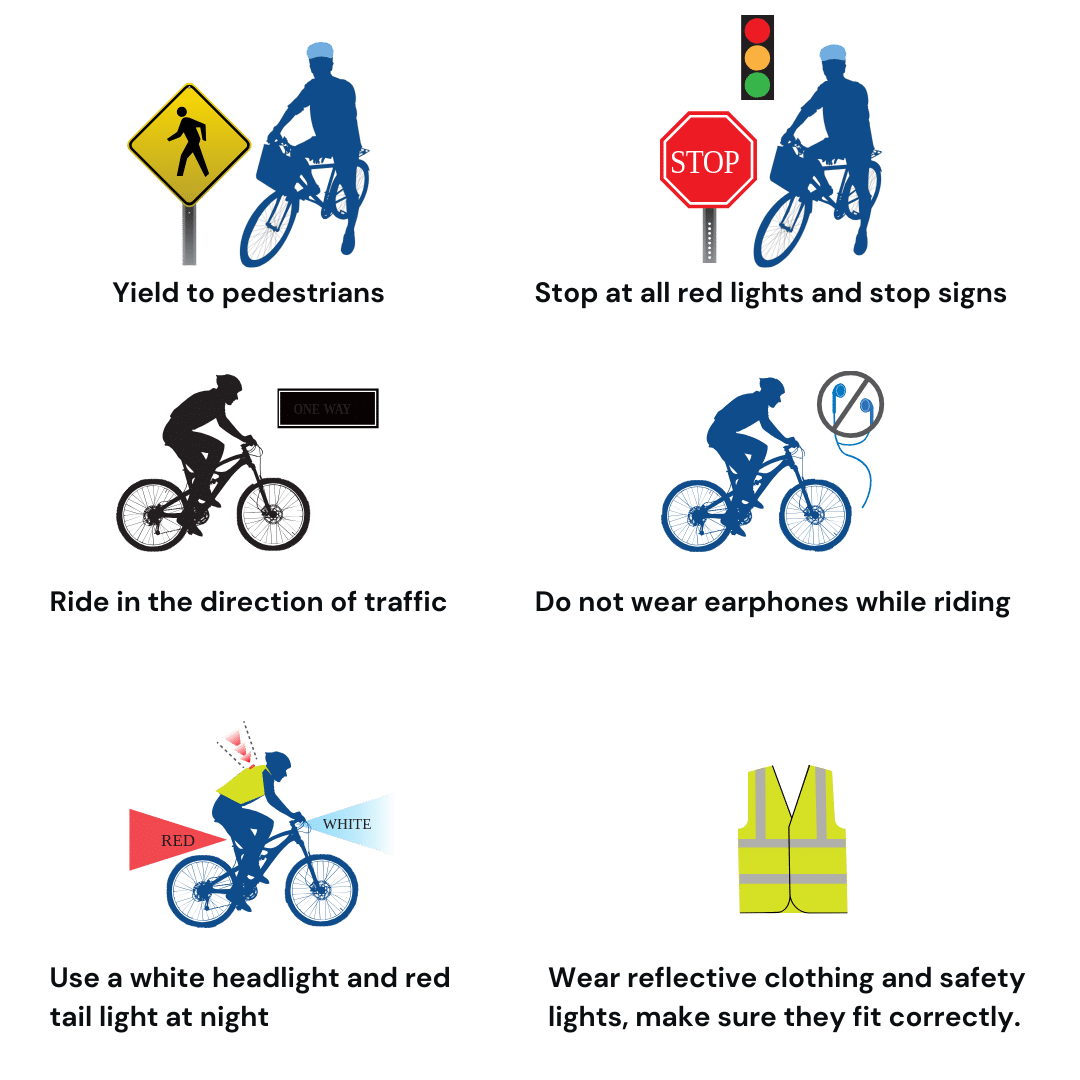
basic biking rules

Please be vigilant about bike and pedestrian safety. Follow the rules of the road as these actions could save your life.

If you need to bike to work, or you ride in your free time, please follow these safety guidelines:

  • Always wear a helmet. In many states, this is the law.
  • If you ride at night make sure your bike has reflectors and lights on the front and back. (InterExchange offers free bike lights; please contact us directly at [email protected] to request one.)
  • Wear bright colors when walking or biking at night.
  • Assure bicycle readiness. Make sure your bicycle is adjusted properly.
  • Scan for traffic and use hand signals when changing lanes and making turns.
  • Obey all traffic laws.
  • Never wear headphones while biking.
  • Cars and bikes drive on the right side of the road.
  • Secure your bike with a lock when not in use.
  • Always ride following the flow of traffic.
  • Do not ride your bike on busy highways or freeways. In many cities, this is illegal.
  • Ride in single file to ensure you are not obstructing traffic. Bicycling side-by-side with another person can be dangerous on the road.

In the past decade, e-bikes and e-scooters have grown in popularity among those seeking more convenient, affordable, and environmentally friendly ways to travel short distances. Despite the many benefits, these devices can reach speeds up to 25 miles per hour, making safety essential for protecting yourself and others sharing the road.

Smart Purchasing and Setup

Choose reputable retailers offering warranted devices that have been certified to meet safety standards by a Nationally Recognized Testing Laboratory (NRTL)

  • Match your device selection to your experience level, intended terrain, and power needs.
  • Always review manufacturer instructions before your first ride and use only original equipment and certified replacement parts.

Battery Safety

Due to the risk of fire, it’s important to charge devices using wall outlets only.

  • Never leave them unattended or charge overnight.
  • Unplug immediately when charging is complete and store in dry areas away from exits and extreme temperatures.
  • Watch for warning signs like odd odors, discoloration, overheating, or unusual sounds. If detected, move the device away from flammables and contact emergency services immediately.

Essential Protection

Helmets should be worn every ride. Choose properly fitted models meeting safety standards. Make yourself more visible with bright, reflective clothing and front/rear lights during low-light conditions. Additional protection includes:

  • Closed-toe shoes
  • Protective eyewear
  • Coverage for arms and legs to minimize skin abrasions in the event of a fall

Legal Compliance and Road Behavior

Research local laws covering speed limits, age restrictions, helmet requirements, and where riding is permitted. Some others may include:

  • Following all traffic signals, signs, and rules while riding in traffic.
  • Always riding in the same direction as other traffic and stay on the right side of the lane.
  • Using hand signals for turns and stops, maintain safe distances from vehicles and other riders
  • Always yielding to pedestrians in crosswalks and shared paths.

Safe Operation

Perform pre-ride safety checks on brakes, tires, and battery. Stay alert with both hands on handlebars, avoiding phone use, headphones, and other distractions. Ride solo only – never carry passengers. Adjust speed for weather conditions, especially on wet or icy surfaces. When riding in groups, maintain spacing and use clear communication signals. Most importantly, never operate under the influence of drugs and alcohol.

Security and Age Guidelines

Protect against theft using high-quality locks and parking in well-lit, visible locations. Consider GPS tracking for recovery assistance. The American Academy of Pediatrics recommends a minimum age of 16 to operate e-bikes and e-scooters in most states. (Note: the minimum age to ride in Illinois is 18.) Young riders need proper training, supervision, and thorough understanding of safety rules and local regulations.

Maintenance and Emergency Response

Regular maintenance according to manufacturer specifications prevents accidents and extends device life. Practice emergency braking techniques, understanding that the weight of your e-bike affects the distance needed to stop. Keep emergency contacts accessible and report safety incidents to authorities. Stay current on product recalls and safety notices.

Whatever method of transportation you choose during your stay in the U.S., it’s important to research the laws and technologies available to you beforehand so you can set yourself up for travel success!